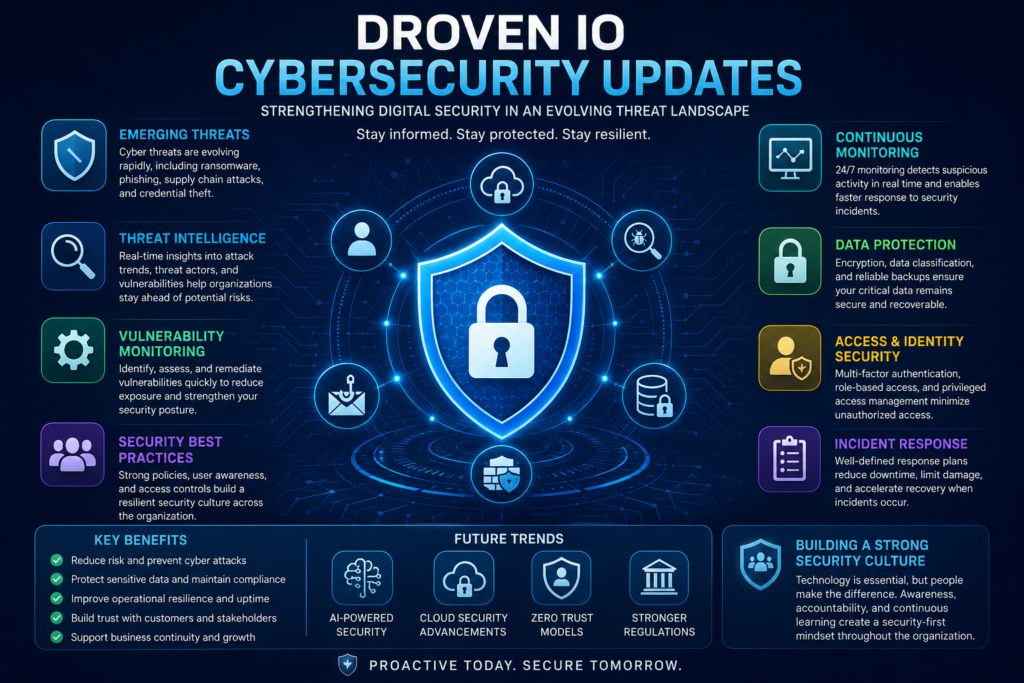
Cybersecurity has become one of the most critical concerns for organizations, professionals, and individual users alike. As digital systems continue to expand and interconnected technologies become a standard part of daily operations, cyber threats have also grown in sophistication. Businesses now face a wide range of risks, including ransomware attacks, phishing campaigns, data breaches, identity theft, and unauthorized network access.
Against this backdrop, Droven IO Cybersecurity Updates have gained attention among technology professionals and security-conscious organizations seeking to stay informed about modern security developments. These updates reflect the growing need for proactive security practices, continuous monitoring, and adaptive defense strategies that can respond to emerging threats in real time.
Rather than treating cybersecurity as a one-time implementation, modern organizations increasingly view it as an ongoing process. Regular updates, threat intelligence, vulnerability assessments, and security enhancements are now essential components of a resilient digital environment.
This article explores the significance of Droven IO Cybersecurity Updates, examines the key areas they address, and discusses how cybersecurity developments continue to shape the future of digital protection.
Understanding the Importance of Cybersecurity Updates
Cybersecurity is not a static field. Threat actors continuously develop new attack methods, exploit newly discovered vulnerabilities, and target organizations through increasingly sophisticated techniques.
A system that was secure six months ago may be vulnerable today if it has not received the latest security updates and protections.
Cybersecurity updates serve several important purposes:
- Address newly discovered vulnerabilities
- Improve threat detection capabilities
- Strengthen access controls
- Enhance data protection mechanisms
- Improve system performance and resilience
- Reduce exposure to emerging attack techniques
For organizations operating in highly connected environments, staying current with security developments is no longer optional. It has become a business necessity.
The Growing Complexity of Modern Cyber Threats
Cyber threats have evolved dramatically over the past decade.
Earlier attacks often relied on relatively simple malware or spam campaigns. Today’s attackers use advanced techniques that may include:
Ransomware Operations
Ransomware remains one of the most damaging cyber threats. Attackers encrypt critical files and demand payment for restoration.
Modern ransomware groups frequently target businesses, hospitals, educational institutions, and government agencies.
Phishing and Social Engineering
Phishing attacks continue to be highly effective because they target human behavior rather than technical weaknesses.
Cybercriminals create convincing emails, websites, and messages designed to trick users into revealing sensitive information.
Supply Chain Attacks
Rather than attacking organizations directly, threat actors may target vendors, software providers, or service partners.
Compromising a trusted supplier can provide access to multiple organizations simultaneously.
Credential Theft
Usernames and passwords remain valuable targets.
Attackers use credential stuffing, brute-force attacks, and stolen databases to gain unauthorized access to systems.
These evolving threats highlight why cybersecurity updates remain a critical component of organizational defense strategies.
How Droven IO Cybersecurity Updates Support Security Awareness
One of the most valuable aspects of cybersecurity updates is their ability to keep organizations informed about emerging risks.
Awareness allows security teams to act before vulnerabilities become major incidents.
Droven IO Cybersecurity Updates typically focus on areas such as:
Threat Intelligence
Threat intelligence helps organizations understand:
- Current attack trends
- Emerging threat actors
- New malware variants
- Active exploitation campaigns
- Industry-specific risks
Timely intelligence enables faster decision-making and more effective defense planning.
Vulnerability Monitoring
New software vulnerabilities are discovered regularly.
Cybersecurity updates help organizations:
- Identify affected systems
- Assess potential risks
- Prioritize remediation efforts
- Reduce exposure windows
Effective vulnerability management significantly lowers the likelihood of successful attacks.
Security Best Practices
Technology alone cannot guarantee security.
Regular guidance on security best practices helps organizations improve:
- Employee awareness
- Access management
- Data handling procedures
- Incident response planning
- Risk assessment processes
These improvements create stronger overall security postures.
Key Highlights
- Cybersecurity threats continue to evolve rapidly across industries.
- Regular updates help organizations address newly discovered vulnerabilities.
- Threat intelligence provides valuable insight into emerging attack patterns.
- Security awareness remains a critical component of defense strategies.
- Strong access controls reduce the likelihood of unauthorized access.
- Continuous monitoring improves threat detection capabilities.
- Employee education helps prevent phishing and social engineering attacks.
- Incident response planning enables faster recovery from security events.
- Data protection measures support compliance and privacy requirements.
- Proactive security practices are more effective than reactive responses.
The Role of Continuous Monitoring
Continuous monitoring has become a cornerstone of modern cybersecurity.
Traditional security approaches often relied on periodic reviews or scheduled audits. While valuable, these methods may miss threats that emerge between assessments.
Continuous monitoring allows organizations to:
Detect Suspicious Activity
Security monitoring systems analyze network traffic, user behavior, and system activity.
Unusual patterns may indicate:
- Unauthorized access attempts
- Malware infections
- Data exfiltration
- Insider threats
Early detection often prevents minor incidents from becoming major breaches.
Improve Incident Response
The faster an organization identifies a threat, the faster it can respond.
Rapid response can:
- Minimize damage
- Protect sensitive data
- Reduce operational disruptions
- Lower recovery costs
Strengthen Compliance Efforts
Many industries operate under strict security and privacy requirements.
Continuous monitoring supports compliance by providing visibility into system activity and security controls.
Data Protection in the Modern Digital Environment
Data is among the most valuable assets organizations possess.
Protecting customer information, financial records, intellectual property, and operational data has become a top priority.
Cybersecurity updates often emphasize data protection strategies such as:
Encryption
Encryption helps protect information both in storage and during transmission.
Even if attackers gain access to encrypted data, the information remains difficult to interpret without the proper keys.
Data Classification
Not all data carries the same level of risk.
Organizations benefit from classifying information according to sensitivity levels and applying appropriate protections.
Backup and Recovery
Reliable backups remain essential for resilience.
In the event of ransomware attacks or system failures, backups help organizations restore operations without significant data loss.
Access Management and Identity Security
Identity security has become increasingly important as organizations adopt cloud services, remote work models, and distributed infrastructures.
Cybersecurity updates frequently focus on strengthening access controls.
Multi-Factor Authentication
Multi-factor authentication requires users to provide additional verification beyond passwords.
This extra layer significantly reduces the effectiveness of stolen credentials.
Role-Based Access Control
Users should only have access to the information and systems necessary for their responsibilities.
Limiting access reduces potential damage if an account becomes compromised.
Privileged Access Management
Administrative accounts possess elevated permissions and therefore require additional protection.
Organizations increasingly implement monitoring and controls specifically designed for privileged users.
Detailed Analysis: Why Proactive Security Outperforms Reactive Security
A common mistake among organizations is assuming that cybersecurity only becomes important after an incident occurs.
Reactive security approaches often result in:
- Higher recovery costs
- Extended downtime
- Reputational damage
- Customer trust issues
- Regulatory consequences
By contrast, proactive security focuses on prevention and preparedness.
Risk Assessment
Regular risk assessments help identify weaknesses before attackers exploit them.
Organizations can then prioritize improvements based on potential impact and likelihood.
Security Training
Human error remains one of the leading causes of security incidents.
Training programs help employees:
- Recognize phishing attempts
- Handle sensitive information responsibly
- Follow security procedures
- Report suspicious activity
Security Testing
Organizations often perform:
- Vulnerability scans
- Penetration tests
- Security audits
- Configuration reviews
These activities reveal weaknesses that may otherwise go unnoticed.
The cumulative effect of these measures creates a stronger and more resilient security environment.
Benefits and Important Facts
- Cybersecurity is an ongoing process rather than a one-time project.
- Most successful attacks exploit known vulnerabilities that have not been addressed.
- Multi-factor authentication significantly improves account security.
- Employee awareness programs reduce social engineering risks.
- Continuous monitoring helps identify threats in real time.
- Data encryption protects information during storage and transmission.
- Regular backups support business continuity during incidents.
- Incident response planning reduces recovery time and operational disruption.
- Access controls limit exposure to unauthorized activities.
- Threat intelligence helps organizations prepare for emerging risks.
Future Trends Influencing Cybersecurity Updates
Cybersecurity continues to evolve alongside technological innovation.
Several emerging trends are expected to influence future security updates.
Artificial Intelligence in Security
Artificial intelligence is increasingly used to:
- Detect anomalies
- Analyze large datasets
- Identify suspicious behaviors
- Improve threat detection speed
AI-powered systems can help security teams respond more efficiently to complex threats.
Cloud Security Advancements
As cloud adoption continues to grow, organizations require stronger cloud security frameworks.
Future updates will likely focus on:
- Cloud visibility
- Configuration management
- Identity governance
- Data protection controls
Zero Trust Security Models
Zero Trust operates on the principle of “never trust, always verify.”
Rather than assuming users or devices are trustworthy based on location, every access request undergoes verification.
This approach is becoming increasingly popular among organizations seeking stronger defenses.
Greater Regulatory Attention
Governments and industry regulators continue to strengthen cybersecurity requirements.
Organizations must remain informed about evolving compliance obligations and security standards.
Building a Strong Security Culture
Technology alone cannot solve every cybersecurity challenge.
Organizations that build strong security cultures often achieve better outcomes than those relying solely on technical controls.
A strong security culture encourages:
- Accountability
- Awareness
- Responsible technology use
- Continuous learning
- Collaboration across departments
Leadership support plays a critical role in fostering these behaviors.
When cybersecurity becomes part of organizational culture, security practices are more likely to be adopted consistently.
Conclusion
Droven IO Cybersecurity Updates highlight the growing importance of maintaining awareness in an increasingly complex digital environment. As cyber threats continue to evolve, organizations must adopt proactive strategies that combine technology, education, monitoring, and continuous improvement.
Modern cybersecurity extends far beyond installing protective software. It involves understanding emerging threats, strengthening access controls, protecting valuable data, training users, and preparing for potential incidents before they occur. Regular updates provide valuable insights that help organizations adapt to changing risks and maintain stronger defenses.
By embracing continuous security improvements and staying informed about the latest developments, organizations can build resilience, reduce vulnerabilities, and better protect the digital assets that drive their operations. In a world where cyber threats are constantly changing, staying current is one of the most effective defenses available.